
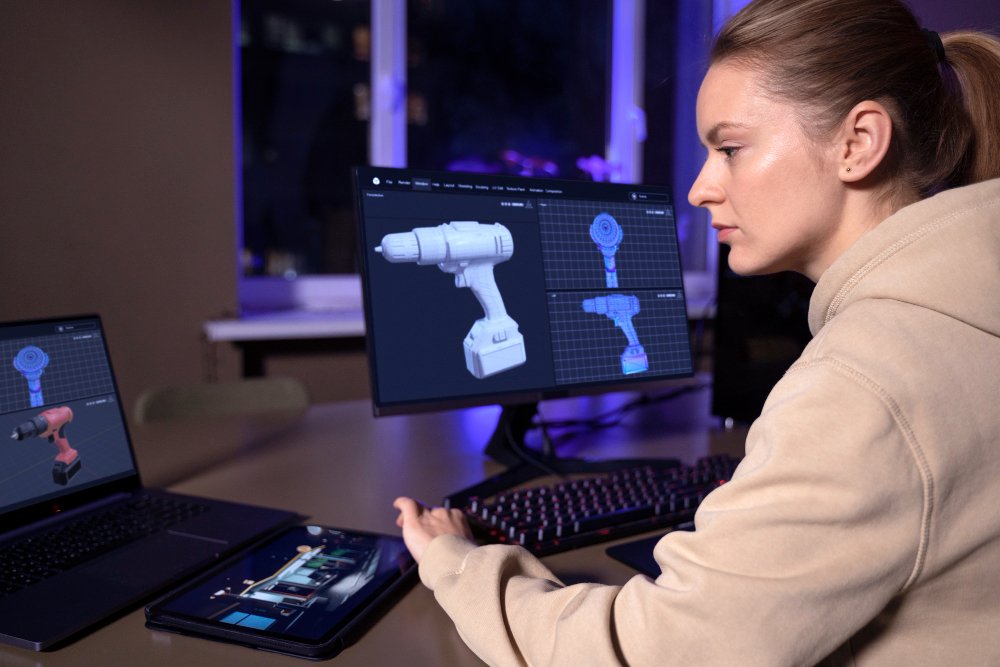
There is a strange moment when you realize that a machine is no longer simply recording the world—it is beginning to interpret it.
A camera has been able to capture an image for more than a century. A video camera can record hours of movement without getting tired. But recording something and understanding it are two completely different capabilities. A traditional camera sees a crowded street as millions of pixels. An AI system can look at that same street and identify cars, pedestrians, traffic signals, road markings, movement patterns, and potentially the relationships between them.
That shift is at the heart of modern computer vision.
What makes this technology particularly interesting is that AI does not literally “see” the way humans do. There are no eyes, visual nerves, or biological brains involved. Instead, machines convert visual information into numerical representations and use trained models to recognize patterns, estimate relationships, classify objects, track movement, and generate useful conclusions.
According to IBM, computer vision is an AI field that allows machines to process, analyze, and interpret visual inputs such as images and videos.
That definition sounds straightforward, but the technology underneath it is anything but simple. Behind a seemingly effortless action—such as an application recognizing a person in a photograph—there may be enormous datasets, neural networks, feature extraction, model training, inference systems, specialized hardware, and carefully designed evaluation processes working together.
The story of how machines learned to understand visual information is therefore not simply a story about cameras or algorithms. It is a story about teaching machines to transform pixels into meaning.
From Pixels to Perception
Consider a photograph of a dog sitting beside a bicycle.
To you, the interpretation is almost instantaneous. You recognize the animal, identify the bicycle, understand their approximate positions, and probably understand the scene without consciously analyzing every visual detail.
A computer starts somewhere very different.
At the most basic level, a digital image is represented as numerical data. Pixels contain values describing characteristics such as color and brightness. The machine does not initially receive the concept of “dog” or “bicycle.” It receives numbers.
The challenge for AI researchers has been figuring out how to transform those numbers into increasingly useful representations.
Early computer vision approaches often depended heavily on manually engineered features. Engineers had to tell systems what types of patterns might matter—edges, corners, textures, shapes, or other visual characteristics. Modern deep learning changed that equation dramatically. Instead of requiring humans to explicitly define every useful visual feature, neural networks can learn representations from large amounts of training data.
This is one reason the rise of deep learning became such an important chapter in visual AI.
A model can encounter thousands or millions of examples and gradually learn which patterns are useful for a particular task. The process is somewhat like training a junior analyst: you don’t simply hand over a dictionary of rules and expect perfect understanding. You provide examples, feedback, corrections, and enough variety for the analyst to learn what actually matters.
The machine doesn’t become conscious of the image. It becomes increasingly effective at recognizing statistical patterns within visual data.
How an AI Model Learns to Recognize an Image
Imagine training a system to identify cats.
The first requirement is data. The system needs many examples of cats, ideally photographed under different lighting conditions, from different angles, at different distances, and in different environments. It also needs examples that are not cats, otherwise the model may learn shortcuts that appear successful during training but fail in real-world situations.
This is where experience in AI development becomes particularly important.
A dataset can look impressive on paper and still produce a weak model. If nearly every cat image contains a particular background, for example, the model may accidentally associate that background with the target category. If the dataset lacks enough variation, performance may collapse when the model encounters an unfamiliar camera angle or environment.
Training quality therefore begins long before the neural network starts calculating predictions.
Once the data is prepared, the model learns relationships within it. Traditional convolutional neural networks, or CNNs, became especially influential because they could learn hierarchical visual representations. Early layers can respond to relatively simple patterns such as edges and textures, while deeper layers can combine those features into increasingly complex structures.
Google Cloud describes CNNs as neural networks designed for visual data in which earlier layers can identify basic features while deeper layers recognize more complex patterns and objects.
The important idea is hierarchy.
A curve alone does not tell a machine that it is looking at a wheel. Several curves and textures together may suggest a wheel. Multiple wheels, a frame, handlebars, and other relationships may eventually suggest a bicycle.
The model gradually builds representations that become useful for the task it has been trained to perform.
Training Is Where the Real Work Happens
One of the biggest misconceptions about AI vision systems is that the model itself is the hardest part.
In real projects, data preparation can be just as challenging—or harder.
Suppose a company wants an AI system to detect defective products on a manufacturing line. The company may need thousands of images showing normal products and different types of defects.
But what counts as a defect?
A scratch that is harmless on one component may be unacceptable on another. A tiny manufacturing variation might be considered normal by one quality-control team and problematic by another. Images may also vary because of lighting, camera position, product orientation, dust, reflections, or changes in production equipment.
The model cannot solve these ambiguities automatically.
Human experts must define the problem, collect representative examples, label data consistently, establish evaluation criteria, and determine what level of error is acceptable.
This is why experienced AI teams spend substantial effort on data quality, annotation, preprocessing, validation, and monitoring.
IBM similarly highlights data gathering, preprocessing, model selection, and training as important stages in building computer vision systems.
The lesson is simple: sophisticated AI does not eliminate the need for good engineering. It makes good engineering more important.
Image Classification Is Only the Beginning
When people hear that AI can “understand an image,” they often imagine a single capability.
In reality, visual AI contains many different tasks.
Image classification asks a relatively broad question: what category does this image belong to?
For example, an AI system might determine whether an image contains a dog, cat, car, airplane, or landscape.
But classification does not necessarily tell you where the object is.
That’s where object detection becomes useful.
An object detection model can identify multiple objects and estimate their locations, commonly by drawing bounding boxes around them. In a street scene, it might detect several cars, pedestrians, motorcycles, buses, and traffic signs simultaneously.
Then there is image segmentation, which goes further by identifying pixels belonging to specific objects or regions.
This distinction becomes extremely important in practical applications. A bounding box may be sufficient for counting vehicles, while a medical imaging system may require much more precise boundaries around an abnormal region.
Other capabilities include object tracking, facial recognition, pose estimation, optical character recognition, scene understanding, and visual inspection. IBM’s current overview of computer vision identifies these as examples of tasks modern visual AI systems can perform.
So when someone says, “AI understands images,” the more accurate question is: understands them for what purpose?
The answer determines the architecture, training data, evaluation process, and deployment strategy.
Videos Create a Much Bigger Challenge
An image is a single visual moment.
A video is a sequence of moments.
That difference changes everything.
Imagine an AI system watching a security camera. It isn’t enough to identify a person in one frame. The system may need to determine whether the person is walking, running, entering an area, leaving a restricted zone, interacting with an object, or remaining stationary for an unusual amount of time.
The meaning is often hidden in motion and context.
A single frame might show a person standing beside a vehicle. Several seconds of video could reveal that the person approached the vehicle, opened the door, entered it, and drove away.
The AI therefore needs mechanisms for analyzing information across time.
Modern video systems can combine object detection and tracking with temporal analysis to understand what is happening across sequences of frames. This allows AI to move from simple recognition toward event and activity understanding.
Google Cloud’s Vision AI ecosystem, for example, supports video analysis capabilities involving object detection and tracking, scene understanding, activity recognition, and related video intelligence tasks.
This is one reason video analysis can become computationally expensive. A single image requires one visual interpretation. A video may contain thousands or millions of frames.
The engineering challenge becomes a balancing act between accuracy, processing speed, storage, latency, and cost.
The Rise of Vision-Language Models
One of the most interesting developments in AI is that visual understanding is no longer isolated from language.
Traditional computer vision might answer:
“There is a car in this image.”
A more advanced multimodal system can potentially answer:
“A red car is parked beside a building while several people stand near the entrance.”
That difference may sound subtle, but technologically it represents a major shift.
Vision-language models combine visual information with language capabilities. Instead of simply assigning labels, these systems can connect what they observe with natural-language descriptions, questions, instructions, and reasoning tasks.
This is where visual AI starts becoming more conversational.
A user can provide an image and ask what appears unusual. A researcher can upload a chart and ask for an explanation. A business user can provide a photograph of a product shelf and ask which products appear to be missing.
Multimodal AI is designed to work across different types of information, including text, images, audio, and video.
The practical significance is enormous because humans rarely experience information in isolated formats.
We see a document, read its text, hear someone explain it, and interpret the surrounding environment simultaneously.
AI is gradually moving in that direction as well.
How AI Understands a Video in Practice
A useful way to understand modern video AI is to imagine a pipeline.
A camera first provides the raw video stream. The system then processes frames or selected portions of the stream. Visual models detect relevant entities, while additional processing tracks those entities and extracts information about movement or interactions.
The system may then store metadata instead of requiring a human to watch the entire recording.
This creates a completely different relationship with video archives.
Imagine a warehouse containing thousands of hours of security footage. Traditionally, finding a particular event might require someone to manually search through recordings.
An AI-powered system can instead generate searchable information about detected people, vehicles, objects, activities, timestamps, or other events.
Google Cloud has described architectures in which video streams are ingested, analyzed using vision models, and associated metadata is stored for later search and analytics.
That is where computer vision becomes more than a recognition technology.
It becomes an information-extraction technology.
The camera creates the raw material. AI converts that material into structured information.
Where Machines Are Already Using Visual Intelligence
The most convincing evidence for visual AI is not found in futuristic demonstrations. It is found in ordinary systems already operating around us.
In healthcare, AI can assist with medical-image analysis by identifying patterns that deserve closer examination. Such systems are not replacements for clinical expertise, but they can help professionals process large volumes of visual information.
In manufacturing, cameras can continuously inspect products and identify defects. Unlike a human inspector, an automated system does not become tired after examining thousands of identical components.
In retail, visual systems can help analyze shelves, inventory, customer movement, and product placement.
In transportation, visual AI can help interpret roads, vehicles, pedestrians, signs, and traffic conditions.
In agriculture, cameras and drones can capture crop imagery that AI systems analyze for plant health, pests, weeds, and other patterns.
Robotics represents another particularly important area because robots need to understand their surroundings before they can interact with them safely.
IBM identifies healthcare, agriculture, autonomous vehicles, robotics, and space exploration among the areas where computer vision is being applied.
The common thread is not simply “seeing.”
It is seeing something useful and acting on the information.
The Edge Changes the Equation
There is another development that matters enormously in real-world deployments: edge AI.
Sending every frame from every camera to a distant cloud server is not always practical. Some applications require extremely low latency. Others operate in environments where connectivity is unreliable or where transmitting sensitive footage creates privacy concerns.
Edge computing allows some AI processing to happen closer to where visual data is generated.
A camera, industrial device, vehicle, smartphone, or embedded computer can process information locally before sending selected results elsewhere.
That can reduce latency and bandwidth requirements.
It can also change the economics of large-scale vision systems.
Consider a factory containing hundreds of cameras. If every frame has to be transmitted continuously for centralized analysis, the infrastructure requirements can become significant. If local systems can identify relevant events first, only useful information may need to be transmitted or stored.
The future of visual AI is therefore not simply about making models more accurate. It is also about making them faster, smaller, cheaper, more private, and easier to deploy.
Why AI Vision Still Makes Mistakes
It would be a mistake to describe visual AI as perfect machine perception.
It isn’t.
AI models can misclassify objects, struggle with unusual viewpoints, fail under poor lighting, misinterpret ambiguous situations, and perform differently when deployed in environments that differ from their training data.
Video introduces additional problems. Objects can become temporarily hidden, cameras can shake, scenes can change suddenly, and events can depend heavily on context.
There are also serious questions around privacy and responsible deployment.
Facial recognition, surveillance systems, workplace monitoring, and automated decision-making can create consequences far beyond a simple incorrect classification.
This is why experienced AI development treats accuracy as only one part of system quality.
A model may have excellent benchmark performance and still be inappropriate for a particular real-world application.
The correct question isn’t merely:
“How accurate is the model?”
It is:
“How does the complete system behave when it encounters the messy reality of the world?”
That distinction separates an impressive demonstration from a dependable production system.
The Future: From Seeing to Understanding
The direction of visual AI is becoming increasingly clear.
Machines are moving from recognizing isolated objects toward understanding richer relationships between objects, environments, actions, language, and events.
A future AI system will not simply identify a person walking through a room. It may understand the room, describe what the person is doing, connect the action with previous events, interpret spoken instructions, and use that information to make a decision.
This is particularly important for AI agents.
An intelligent agent needs to perceive its environment before it can make meaningful decisions. Visual perception can therefore become one component of a broader system that combines vision, language, audio, sensors, memory, reasoning, and action.
IBM describes AI-agent perception as the ability to gather and interpret information from an environment so that an agent can make informed decisions, with visual perception being one part of that larger capability.
This points toward a world where AI doesn’t merely process pictures.
It interacts with environments.
The Real Transformation Is Happening Between Pixels and Decisions
When you look at an image, you don’t consciously think about individual pixels.
You see a scene.
You recognize objects.
You understand relationships.
You infer what might happen next.
AI is gradually learning to perform increasingly sophisticated versions of those operations, but through mathematical representations rather than human biological perception.
That distinction matters.
The real achievement of modern visual AI isn’t that machines can technically “see.” Cameras have been collecting visual data for generations.
The breakthrough is that AI can increasingly transform that visual data into structured information, predictions, descriptions, and actions.
A photograph can become a searchable record. A video can become a collection of events. A medical scan can become an analytical aid. A factory camera can become a quality-control system. A robot’s camera can become part of its perception of the physical world.
And this is only the beginning.
As vision models become more capable and increasingly connect with language, reasoning, robotics, and AI agents, the boundary between seeing and understanding will continue to become less obvious.
The camera gave machines eyes.
AI is teaching them what those eyes can mean.
Conclusion
The journey from pixels to machine understanding has been one of the most important developments in artificial intelligence. What began with relatively simple attempts to detect shapes and patterns has evolved into sophisticated systems capable of classification, object detection, segmentation, tracking, visual inspection, video analysis, and multimodal interaction.
The biggest lesson from real-world AI projects is that successful visual intelligence isn’t created by choosing a fashionable model and feeding it images. It depends on the entire ecosystem: representative data, reliable labeling, appropriate architectures, strong evaluation, efficient inference, careful deployment, and continuous monitoring.
Today, AI can already extract remarkable amounts of information from images and videos. Tomorrow’s systems will increasingly connect that information with language, reasoning, sensors, and autonomous action.
That is the real story of machine vision.
It isn’t about teaching computers to look like humans.
It is about giving machines a computational way to interpret the visual world—and then turning what they interpret into something useful.