
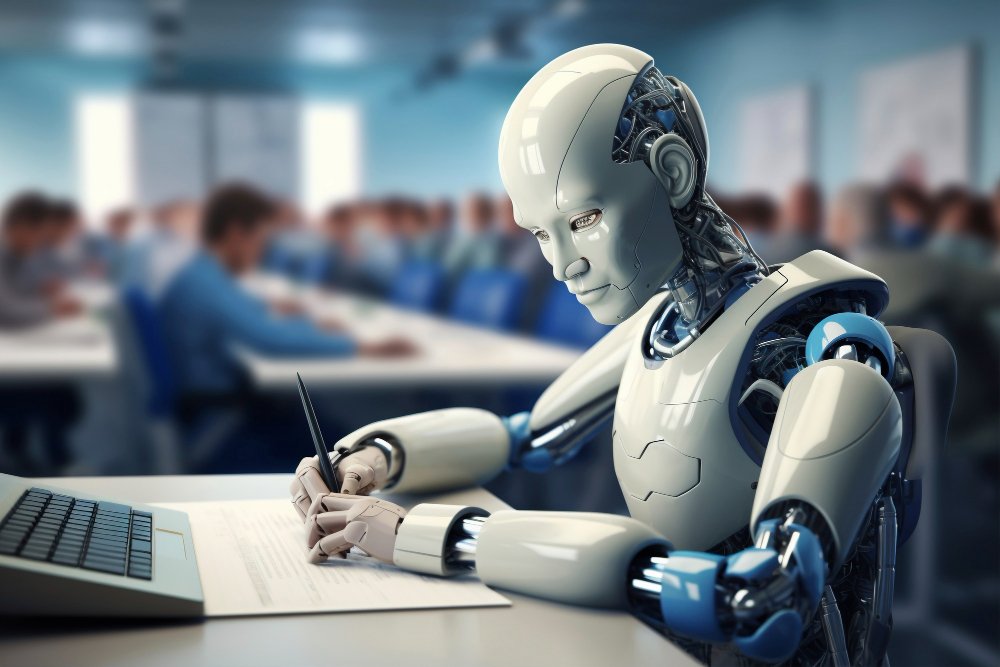
Artificial intelligence is changing how students learn, how teachers prepare lessons, and how educational institutions deliver knowledge. Instead of relying exclusively on textbooks, recorded lectures, and fixed learning schedules, students can now use AI-powered tools to explore concepts, practice skills, receive explanations, and identify gaps in their understanding.
Consider a student struggling to understand a mathematical formula. In a traditional learning environment, the student might wait until the next class to ask the teacher for help. With an AI-powered learning assistant, the student can request a simpler explanation, review a worked example, and practice similar problems immediately.
This illustrates an important shift: AI is making education more adaptable, interactive, and responsive to individual learning needs.
However, technology alone does not guarantee better education. An AI system can explain a concept incorrectly, provide misleading feedback, or encourage students to depend on automated answers instead of developing their own reasoning skills. The real opportunity lies in combining AI capabilities with effective teaching, meaningful practice, and human judgment.
In this lecture, we will examine how AI is transforming education and e-learning, explore practical applications for students and educators, and identify the challenges that must be addressed to make AI-supported learning genuinely effective.
Learning Outcomes
By the end of this lecture, you should be able to:
- Explain how artificial intelligence is changing education and online learning.
- Identify the major applications of AI in teaching, assessment, and student support.
- Understand how personalized learning and intelligent tutoring systems work.
- Evaluate the benefits and limitations of AI-powered educational tools.
- Apply practical strategies for using AI to improve learning outcomes.
- Recognize important issues involving privacy, academic integrity, bias, and accessibility.
Lesson 1: Understanding the Role of AI in Education
Artificial intelligence in education refers to the use of AI-powered systems to support teaching, learning, assessment, and educational administration. These systems can analyze information, generate educational content, respond to questions, recognize patterns in student performance, and help educators organize their work.
In e-learning, AI adds an intelligent layer to digital education. A traditional online course may present the same video, reading material, and quiz to every learner. An AI-supported platform can potentially adjust practice questions, recommend additional resources, or explain difficult concepts according to a student’s needs and progress.
To understand this distinction, imagine an online English course.
A conventional platform might ask every student to complete the same grammar exercise. An AI-supported system could identify that one student struggles with verb tenses while another needs help with sentence structure. Each learner could then receive different practice activities.
The educational objective remains the same, but the learning process becomes more flexible.
It is important to distinguish AI from ordinary educational technology. A video player, digital textbook, or basic online quiz does not necessarily use AI. AI becomes relevant when a system uses techniques such as machine learning or language processing to interpret information, generate responses, make predictions, or adapt its behavior.
Lesson 2: Personalized Learning and Intelligent Tutoring
One of AI’s most promising applications is personalized learning.
Students do not learn at identical speeds. Some understand a concept immediately, while others need additional explanations, repeated practice, or a different teaching approach. In large classrooms and self-paced online courses, meeting every student’s individual needs can be difficult.
AI can help address this challenge by supporting learning experiences that respond to individual performance.
How personalized learning works
An AI-enabled learning system may use information such as quiz answers, completed activities, and recurring errors to recommend the next learning step. Depending on the system, it might suggest a review exercise, provide a simpler explanation, or introduce a more challenging activity.
For example, a student learning algebra repeatedly makes mistakes when solving equations involving negative numbers. Instead of simply presenting another general lesson, an adaptive system might recommend several exercises focused on that particular skill.
This process can help students identify weaknesses before moving to more advanced material.
However, an incorrect answer does not always mean a student lacks understanding. The mistake may result from a misunderstood question, a typing error, or an unfamiliar format. AI recommendations should therefore be treated as useful signals rather than definitive judgments about a learner’s ability.
AI as a personal study assistant
Students can also use conversational AI to request explanations tailored to their current level.
A student might ask:
“Explain photosynthesis to a 12-year-old. Use a simple analogy, describe the role of sunlight, and give me three questions to test my understanding.”
The AI can respond with a customized explanation and follow-up questions.
This approach is particularly useful when students need additional practice outside scheduled classes. Nevertheless, students should compare important explanations with their textbooks, course materials, and teachers’ guidance.
Lesson 3: How AI Is Transforming the Work of Teachers
AI in education is not only about students. Teachers can use it to reduce repetitive preparation work and devote more time to activities that require human judgment.
Lesson planning and educational materials
Preparing a lesson often involves developing explanations, worksheets, examples, activities, and assessments. AI can assist with producing initial drafts of these materials.
For example, a teacher could request a 40-minute lesson plan on fractions for middle-school students, including a warm-up activity, a worked example, group practice, and a short assessment.
The teacher can then review the draft, correct errors, adapt it to the curriculum, and ensure that the activities are appropriate for the students.
AI-generated lesson plans should be treated as starting points rather than finished educational products. The teacher remains responsible for instructional quality.
Differentiated instruction
A classroom may contain students with different levels of prior knowledge, language abilities, and learning needs. AI can help educators prepare alternative explanations or exercises for the same learning objective.
For instance, a teacher could create:
- A foundational worksheet for students who need extra practice.
- A standard worksheet aligned with the lesson.
- An advanced activity requiring students to apply the concept to a new problem.
The teacher can review each version to ensure that the materials remain accurate and appropriately challenging.
Administrative assistance
AI may also assist with drafting routine communications, organizing lesson resources, summarizing non-sensitive feedback, and creating assessment rubrics.
These applications can reduce repetitive work, but schools should establish clear rules about student data, automated grading, and the use of AI in consequential decisions.
Lesson 4: AI-Powered Assessment and Instant Feedback
Traditional assessment often provides feedback after an assignment or examination has been completed. AI can support faster feedback during the learning process, allowing students to correct mistakes while the material is still fresh.
For example, an online writing platform might identify a sentence with unclear wording and suggest ways to improve it. A mathematics system could flag an incorrect step and offer a hint instead of immediately displaying the final answer.
The distinction between feedback and answer generation matters. If students receive completed solutions every time they struggle, they may finish their assignments without developing the underlying skills.
A more effective approach encourages learners to think.
Consider this example:
Less effective feedback: “The answer is 24. Copy this solution.”
More useful feedback: “Check the multiplication in your second step. What do you get when you multiply these two numbers? Try correcting that step before continuing.”
The second approach invites the learner to diagnose and correct the error.
AI can also help teachers identify patterns in class performance, such as a question that many students answered incorrectly. The teacher can use that information to decide whether the topic needs to be explained again.
Automated feedback is not always correct, however. Open-ended responses, creative work, complex reasoning, and assessments with high consequences require appropriate human review.
Lesson 5: Making E-Learning More Interactive and Accessible
Online learning can provide flexibility, but it also creates challenges. Students may feel isolated, struggle to remain motivated, or find it difficult to ask questions when they encounter unfamiliar material.
AI can make digital learning more interactive through conversational tutoring, practice activities, language support, and personalized explanations.
Conversational learning
Instead of watching a lecture passively, students can ask questions about a topic and request alternative explanations.
For example, a learner studying the water cycle could ask the AI to explain evaporation through an everyday example, compare condensation with precipitation, and then provide a short quiz.
This creates opportunities for active engagement with the material.
Language learning
AI tools can support vocabulary practice, grammar feedback, conversational exercises, and reading comprehension. Learners can practice at their own pace and request clarification when a phrase is unfamiliar.
However, AI-generated language feedback may overlook cultural context, natural expressions, or subtle grammatical differences. Teachers and reliable learning resources remain valuable for confirming corrections.
Accessibility and inclusive learning
AI can assist with features such as speech-to-text, text-to-speech, automatic captions, text simplification, and translation. These capabilities may help learners engage with educational materials in different ways.
The actual benefits depend on the quality of implementation. Automatic captions can contain errors, translations may lose meaning, and some platforms may not work well with assistive technologies.
Accessibility must therefore be tested with the learners who will use the system, rather than assumed from the presence of an AI feature.
For educators seeking practical ideas, the independent AI in Education Knowledge Base provides a collection of educational AI tools, teaching activities, and instructional resources. It can serve as a starting point for exploring approaches that may suit different classroom and e-learning needs.
Lesson 6: The Challenges and Risks of AI in Education
The advantages of AI must be evaluated alongside its limitations. A tool that saves preparation time but gives students inaccurate information may create more work than it removes.
Accuracy and misinformation
Generative AI can produce explanations that sound convincing but contain factual errors. It may also invent references, misinterpret a question, or overlook important qualifications.
Students should verify important information using course textbooks, trusted educational resources, and original research when appropriate.
Academic integrity
AI can generate essays, solve problems, summarize readings, and produce computer code. These capabilities create questions about what students have actually learned and which forms of assistance are acceptable.
Schools should communicate their expectations clearly. Depending on the assignment, students might be permitted to use AI for brainstorming but required to write their final analysis independently. In other cases, AI-assisted work may be allowed if its use is disclosed.
The objective should be to assess genuine learning rather than simply prohibit or encourage every possible use of AI.
Privacy and student data
Educational platforms may process personal information, learning records, written assignments, and performance data. Schools and students should understand what information a service collects, how it is stored, and whether it may be used for additional purposes.
Avoid entering identifiable student records or confidential educational information into tools that have not been approved for that purpose.
Bias and unequal access
AI systems may perform differently across languages, cultural contexts, and student populations. If training data or system design does not adequately represent particular groups, the resulting feedback may be less useful or unfair.
Access is another concern. Students without reliable internet connections, suitable devices, or paid subscriptions may not receive the same benefits as better-resourced learners.
For this reason, schools should evaluate not only what an AI tool can do but also who can access it, who may be disadvantaged, and what alternatives are available.
Lesson 7: A Practical Framework for Using AI to Improve Learning
Understanding AI’s capabilities is only the first step. The next is learning to use them in ways that support real educational outcomes.
The following framework can help students and teachers evaluate an AI-supported learning activity.
Step 1: Define the learning objective.
Start by identifying the knowledge or skill the student should develop. For example, the goal might be to explain a scientific process or solve equations independently.
Step 2: Choose an appropriate AI-supported activity.
Select a tool or task that supports the objective. Use a conversational tutor for explanations, a practice generator for revision, or a writing assistant for feedback.
Step 3: Ask for guidance rather than automatic completion.
Encourage the AI to explain concepts, offer hints, ask questions, and provide examples instead of immediately completing the entire assignment.
Step 4: Check the response.
Compare factual claims with reliable materials. Test calculations, review examples, and investigate any explanation that seems inconsistent.
Step 5: Practice independently.
After receiving assistance, ask the student to solve a similar problem without AI support. This helps determine whether the student has understood the concept.
Step 6: Evaluate the learning outcome.
Measure success by what the learner can explain, apply, or demonstrate independently—not simply by how polished the AI-generated output appears.
This framework makes AI a support system for learning rather than a substitute for it.
Lesson 8: The Future of AI in Education and E-Learning
As AI technologies develop, educational platforms may become increasingly capable of combining tutoring, assessment, multimedia content, and learning analytics in a single environment.
Students may be able to move between written explanations, audio discussions, interactive simulations, and personalized practice within one learning experience. Teachers may gain more flexible tools for preparing materials and identifying areas where students need support.
AI may also help expand access to educational resources for learners who cannot attend conventional classes or obtain specialized tutoring.
Yet technological development does not remove the need for good teaching. Effective education depends on clear learning objectives, thoughtful instructional design, meaningful feedback, social interaction, and opportunities to practice independently.
Institutions will need to invest in teacher training, student privacy, accessibility, infrastructure, and responsible assessment practices. They will also need to evaluate whether AI-supported programs actually improve learning rather than assuming that newer technology automatically produces better results.
The most useful future is not necessarily one in which AI performs every educational task. It is one in which AI handles appropriate supporting activities while teachers and students remain actively involved in the learning process.
Frequently Asked Questions
1. How is AI changing education?
AI is supporting personalized learning, conversational tutoring, lesson preparation, assessment feedback, accessibility, and educational administration. Its effectiveness depends on the quality of the tools and how they are used.
2. How does AI improve e-learning?
AI can make e-learning more interactive by providing tailored explanations, recommending practice activities, answering questions, and helping learners identify knowledge gaps.
3. Can AI replace teachers?
AI can assist with some instructional and administrative tasks, but it cannot reliably replace the full range of human teaching responsibilities, including relationship-building, classroom judgment, mentorship, and supporting students’ social and emotional development.
4. What are the main benefits of AI in education?
The potential benefits include more flexible learning, quicker feedback, assistance with educational materials, improved accessibility, and additional opportunities for practice.
5. What are the disadvantages of AI in education?
Major concerns include inaccurate information, privacy risks, bias, academic misconduct, overdependence, and unequal access to technology.
6. How can students use AI responsibly?
Students can use AI to clarify concepts, practice skills, generate revision questions, and receive feedback. They should verify important information, follow institutional rules, protect private data, and complete learning tasks in ways that develop their own abilities.
7. Is AI useful for online teachers?
Yes. AI can help online teachers prepare lessons, develop quizzes, create alternative explanations, organize learning materials, and provide initial feedback. Teachers should review the output before using it with students.
Conclusion: Technology Should Strengthen the Learning Process
Artificial intelligence is creating new opportunities for education and e-learning by making explanations more accessible, supporting personalized practice, assisting teachers, and helping students receive feedback more quickly.
Its greatest value, however, is not measured by how many tasks it can automate. It is measured by whether learners develop stronger understanding, better problem-solving skills, and greater independence.
For students, this means using AI to explore ideas, ask better questions, and practice challenging concepts rather than simply obtaining completed answers. For teachers, it means treating AI as a useful assistant while retaining responsibility for educational decisions. For institutions, it means adopting technology with attention to privacy, fairness, accessibility, and measurable learning outcomes.
The future of education will depend not only on how intelligent our tools become, but also on how thoughtfully we use them to help people learn.