
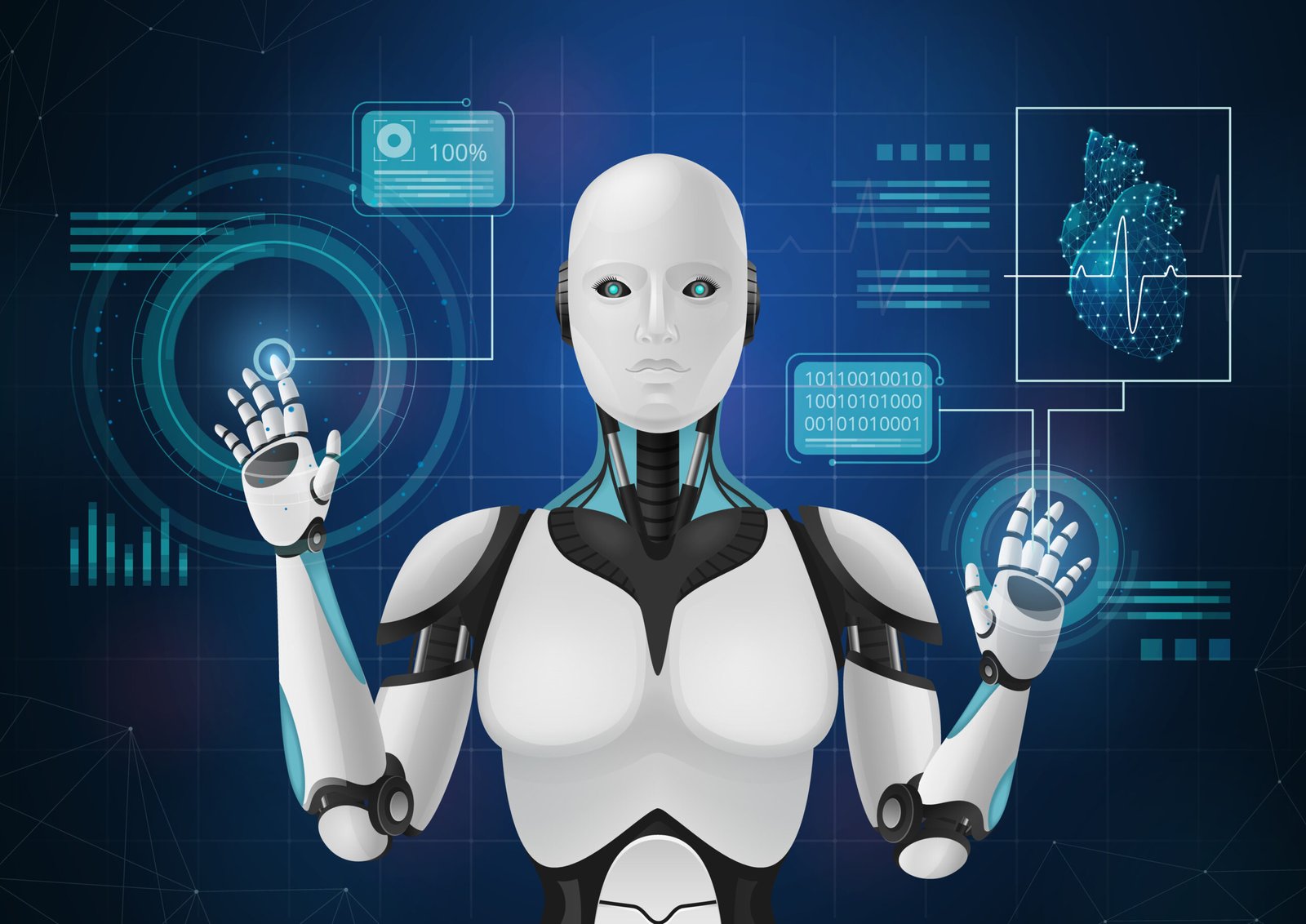
Artificial intelligence is entering a different phase.
For years, the public face of AI was a chatbot waiting for a question. You typed something, the system generated an answer, and the interaction ended. That model is already beginning to feel limited.
The next generation of AI is being designed to reason through problems, remember context, use software, work with multiple types of information, operate inside businesses, and eventually interact with the physical world.
The shift is visible in current research and industry development. Stanford’s 2026 AI Index reports that AI capabilities continued accelerating, while AI agents made substantial progress on computer-use tasks. At the same time, robotics remains much harder in unpredictable real-world environments than in controlled settings.
So what happens next?
Nobody can describe the future of AI with complete certainty. Technology rarely develops in a perfectly straight line. Some ideas will mature faster than expected, while others will take years longer than predicted.
But several trends are already becoming difficult to ignore.
Here are 10 major artificial intelligence trends that could shape the coming years.
1. AI Agents Will Move Beyond Simple Question-and-Answer
The biggest change may not be another chatbot with a larger vocabulary.
It may be the rise of AI agents.
A traditional AI assistant generally waits for instructions:
“Write an email.”
An agentic system can potentially take a broader objective:
“Prepare the client report, review the latest project information, identify the missing numbers, create a presentation, and organize the follow-up tasks.”
The difference is important.
Instead of generating one response, an agent can be designed to break a goal into smaller actions, interact with software, retrieve information, evaluate intermediate results, and continue working through a process.
Current benchmarks already show significant progress. Stanford’s 2026 AI Index reports that computer-use agent performance on OSWorld increased from roughly 12% to 66.3%, although agents still fail a substantial portion of structured tasks.
This suggests that future AI systems may increasingly function like digital workers or software collaborators, rather than passive tools.
Businesses could eventually use specialized agents for research, customer support, coding, scheduling, data analysis, documentation, and internal operations.
The important question will not simply be, “Can AI answer this?”
It will become:
“Can AI complete the entire workflow reliably?”
2. AI Will Become More Multimodal
Human beings do not experience the world through text alone.
We see images. We listen to conversations. We watch videos. We interpret documents, diagrams, facial expressions, sounds, environments, and physical objects.
AI is moving in the same direction.
Multimodal AI allows models to process and connect different types of information, including text, images, audio, video, and other data.
Imagine uploading a product demonstration video and asking an AI system to:
- identify the important moments,
- summarize the conversation,
- extract customer questions,
- analyze visual problems,
- create a written report,
- and generate follow-up content.
That is considerably different from asking a chatbot to summarize a paragraph.
Multimodal systems could influence education, healthcare, marketing, entertainment, customer service, accessibility, research, and professional software.
Gartner identified multimodal capabilities alongside agentic AI, domain-specific models, and smaller reasoning models as important emerging forces for GenAI adoption over the next two years.
The future AI interface may therefore feel less like a text box and more like a universal input layer for digital information.
3. AI Reasoning Will Become More Important Than Raw Model Size
There was a period when AI progress was often discussed through the size of models.
More parameters.
More training data.
More computing power.
The next stage is increasingly focused on something more practical: reasoning and reliability.
A useful AI system needs to do more than produce fluent sentences. It needs to understand a problem, work through constraints, recognize errors, and reach a defensible result.
This is particularly important in areas such as mathematics, programming, scientific research, engineering, finance, and technical analysis.
Stanford’s 2026 AI Index notes that frontier models have made major gains on difficult reasoning and science evaluations, while also warning that some established benchmarks are becoming saturated or have reliability problems.
That creates an interesting future.
AI developers will increasingly compete not only on how much a model knows, but on:
- how accurately it reasons,
- how consistently it performs,
- how efficiently it reaches an answer,
- how well it handles uncertainty,
- and how reliably it can complete complex tasks.
This could make smaller, specialized reasoning models increasingly valuable alongside enormous general-purpose systems.
4. Smaller and Specialized AI Models Will Gain Ground
Bigger is not always better.
A company does not necessarily need the largest AI model available to classify customer tickets, analyze invoices, detect manufacturing defects, or summarize internal documents.
For many applications, a smaller specialized model may be cheaper, faster, easier to deploy, and easier to control.
This is why domain-specific AI is becoming an important part of the future.
A legal organization might use a model optimized for legal documents.
A hospital could require systems designed around medical information.
A manufacturer might deploy models specifically trained for industrial inspection.
A financial organization could build AI around highly structured financial workflows.
Gartner specifically points to domain-specific models and smaller reasoning models as emerging trends that could help organizations scale generative AI applications.
This could create a more diverse AI ecosystem.
Instead of one model attempting to do everything, thousands of specialized systems may quietly operate behind everyday applications.
5. AI Will Become a More Natural Part of Everyday Software
There was a time when “using AI” felt like opening a dedicated AI website.
That distinction may gradually disappear.
AI is increasingly being integrated directly into software people already use.
Instead of opening a separate application to summarize a document, users may simply ask the document editor to do it.
Instead of manually searching through a large database, an employee may ask a workplace system to find the relevant information.
Instead of navigating through dozens of menus, users may describe what they want in natural language.
Microsoft Research describes this broader movement as a shift toward AI systems that can maintain context, work with tools, and support longer-running tasks.
The result could be a subtle but significant change:
AI may become less visible while becoming more useful.
People might not even think of themselves as “using an AI tool.” They will simply use software that happens to understand what they are trying to accomplish.
6. AI Memory Will Create More Personalized Systems
Today’s AI interactions often feel disconnected.
You explain something in one conversation, start another session, and repeat the background information.
Future AI systems are increasingly being designed around persistent context and memory.
Imagine an AI assistant that understands:
- your ongoing projects,
- preferred writing style,
- recurring tasks,
- previous decisions,
- frequently used tools,
- long-term goals,
- and the context surrounding a particular piece of work.
Microsoft Research has highlighted memory and long-term context as important components of emerging agentic systems.
This could make AI considerably more useful.
A personal AI assistant might remember how a project has evolved instead of treating every prompt as an isolated request.
However, memory also introduces serious questions about privacy, security, data ownership, and user control.
The future therefore isn’t simply about giving AI a better memory.
It is about giving users meaningful control over what the system remembers and why.
7. Physical AI and Robotics Will Bring Intelligence Into the Real World
AI has spent much of its recent history inside computers.
The next frontier is physical.
Robotics companies are working toward machines capable of perceiving environments, understanding instructions, manipulating objects, and adapting to changing situations.
This is sometimes described as physical AI.
A future robot might receive an instruction in ordinary language, inspect its surroundings, determine the necessary steps, and perform the task without requiring every movement to be explicitly programmed.
Microsoft Research describes emerging vision-language-action systems as a pathway toward robots that can perceive, reason, and act in dynamic environments.
But this area also illustrates why AI progress should not be confused with science fiction.
Stanford’s 2026 AI Index reports that robots perform very well in some controlled environments but succeed on only about 12% of tested household tasks, demonstrating the difficulty of dealing with unpredictable physical environments.
The future of robotics is therefore likely to arrive unevenly.
Factories and warehouses may see advanced applications earlier than ordinary homes, where environments are less predictable.
8. AI-Generated Video, Audio, and Interactive Media Will Become More Capable
Generative AI has already changed text and image creation.
The next major expansion is increasingly centered on video, audio, animation, and interactive experiences.
Creators can now experiment with an AI video generator to turn concepts into visual content much faster, while other AI tools for content creation are becoming part of everyday marketing and publishing workflows.
Future systems could allow creators to describe an entire visual sequence using natural language and then modify individual elements without rebuilding the project manually.
A filmmaker might generate early visual concepts.
A marketing team could produce localized campaign variations.
A game developer could create interactive environments.
An educator could turn a lesson into a short animated explanation.
This does not necessarily mean human creators disappear.
Instead, the creative workflow could change.
The person may spend less time performing repetitive production work and more time defining the concept, reviewing results, correcting errors, and making creative decisions.
The competitive advantage may increasingly come from knowing what to create and how to direct AI, rather than simply knowing how to operate traditional software.
9. AI Safety, Governance, and Trust Will Become Core Technology Issues
The more capable AI becomes, the more important reliability becomes.
An AI system used to brainstorm social media ideas can tolerate occasional mistakes.
An AI system involved in healthcare, finance, cybersecurity, infrastructure, or legal processes requires a much higher standard.
This is why AI safety and governance are becoming part of the technology conversation rather than being treated as an afterthought.
The National Institute of Standards and Technology’s AI Risk Management Framework provides organizations with a structured approach for identifying and managing AI risks, while its generative AI profile addresses risks that are new or intensified by generative systems.
Future AI development will therefore involve more attention to:
- model evaluation,
- security,
- privacy,
- transparency,
- human oversight,
- data quality,
- bias management,
- monitoring,
- and accountability.
For organizations adopting AI, simply having a powerful model will not be enough.
They will need to demonstrate that the system can be trusted for the job it has been given.
10. AI Will Shift From a Tool to a Long-Term Collaborator
Perhaps the most interesting trend is the combination of everything discussed above.
Imagine an AI system that can:
- understand text,
- see images,
- listen to audio,
- remember previous interactions,
- reason through complicated problems,
- access software tools,
- perform multi-step tasks,
- and coordinate with other AI systems.
That is a very different concept from the chatbot model people became familiar with in the early generative AI era.
Microsoft Research describes emerging systems that can maintain evolving context, collaborate with people, and perform increasingly complex long-running tasks.
The relationship between humans and AI could therefore become more collaborative.
Instead of:
Human → Prompt → AI → Answer
the workflow could become:
Human → Goal → AI plans → AI acts → Human reviews → AI improves the work
That distinction could reshape knowledge work.
The human remains responsible for defining objectives, applying judgment, checking important outcomes, and deciding what should ultimately happen. AI increasingly handles the computational and repetitive parts of the process.
What Will the Future of AI Actually Look Like?
The future probably will not arrive as one dramatic invention.
It will arrive through thousands of smaller changes.
A search engine becomes more conversational.
An office application becomes more autonomous.
A video editor becomes generative.
A robot learns to understand natural language.
A medical system combines images with clinical information.
A business deploys an AI agent that quietly handles a repetitive workflow.
Individually, these developments may not look revolutionary.
Together, they represent a fundamental change in how people interact with technology.
The 2026 AI Index shows just how quickly the field is moving: AI capability continues to advance, organizational adoption has reached very high levels, and frontier systems are increasingly capable across language, reasoning, coding, multimodal tasks, and other domains.
Yet the same evidence also shows limitations.
AI agents still make mistakes.
Robots struggle outside controlled environments.
Benchmarks can become unreliable.
Advanced systems require significant computing resources.
And powerful AI creates new security, privacy, and governance challenges.
So the most realistic vision of the future is not an overnight transition to machines that can do everything.
It is a gradual movement toward more capable, more autonomous, more multimodal, and more deeply integrated AI systems.
How Businesses Should Prepare for the Next AI Wave
Organizations do not necessarily need to chase every new AI release.
A better approach is to identify where AI can solve a genuine operational problem.
Start by examining repetitive workflows.
Where do employees spend hours searching for information?
Where are documents processed manually?
Which customer questions appear repeatedly?
Which reporting tasks consume valuable time?
Where does data need to be summarized or organized?
These are often better starting points than simply asking, “How can we use AI?”
Organizations should also establish clear processes for evaluating AI outputs.
For high-impact applications, human review, security controls, privacy protections, testing, and monitoring should be considered from the beginning. NIST’s AI Risk Management Framework provides one established reference point for organizations developing such practices.
The organizations that benefit most from future AI may not necessarily be those that adopt the greatest number of tools.
They may be the ones that understand where AI belongs—and where it doesn’t.
The Bigger Picture
Artificial intelligence is moving through an important transition.
The first major wave introduced people to conversational AI and generative content.
The next wave is about action.
AI will increasingly be expected to understand context, reason through problems, use tools, work across different media, operate within business processes, and eventually interact with physical environments.
That does not mean every prediction about AI will come true.
Technology has a long history of producing unexpected outcomes. Some promised breakthroughs arrive late. Others emerge in forms nobody originally anticipated.
But the direction is increasingly visible.
AI is becoming less like a standalone application and more like an intelligence layer embedded across the digital and physical world.
For individuals, businesses, developers, researchers, and creators, the important skill will not simply be learning one AI tool.
It will be learning how to work effectively with systems that are becoming increasingly capable, autonomous, multimodal, and context-aware.
The future of AI is therefore not just about smarter machines.
It is about a changing relationship between people, software, data, and intelligent systems.
And that transformation has only just begun.