
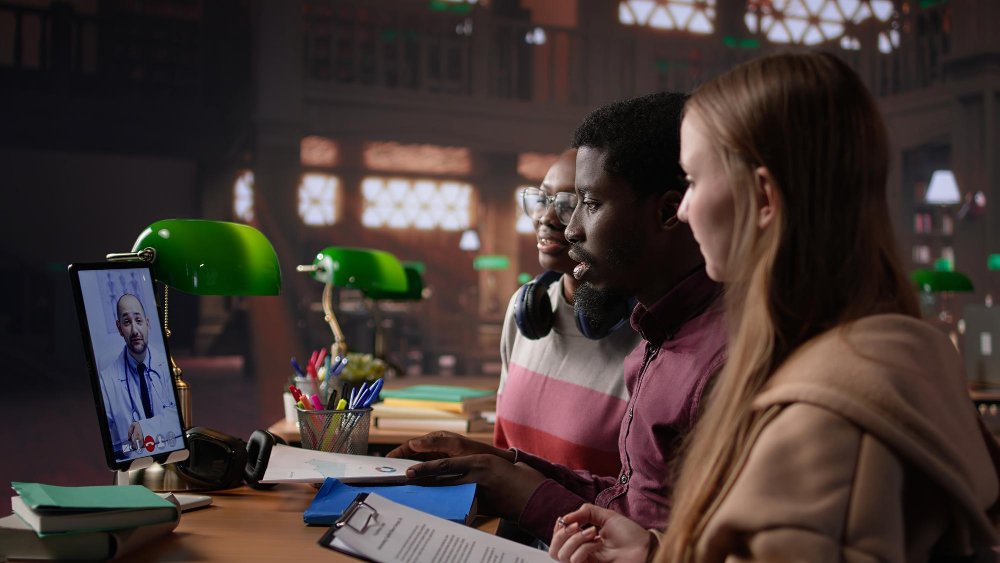
The setting: Offices, classrooms, home workspaces, and digital environments where artificial intelligence is becoming part of everyday life.
The central question: What happens when people no longer have to do everything themselves, but must learn how to work alongside intelligent machines?
Scene 1: The Beginning of a Different Workday
The day begins with a familiar routine. A professional opens a laptop, reviews a crowded inbox, prepares for a meeting, and begins working through a list of unfinished tasks. But something has changed.
An AI assistant summarizes lengthy documents before the first meeting begins. Another tool organizes information, identifies patterns in data, and prepares an initial draft of a report. Tasks that once required hours of manual effort can now be completed in minutes, although the results still need human review.
This is not a distant vision of the future. It is an emerging reality in workplaces around the world.
Artificial intelligence is changing the relationship between people and their work. Rather than simply introducing another piece of software, it is beginning to influence how decisions are made, how information is processed, and how time is spent.
For some workers, AI offers a chance to escape repetitive tasks and focus on creative or strategic responsibilities. For others, it introduces uncertainty about job security, professional skills, and the future value of their experience.
The transformation is not identical for everyone. Its impact depends on the industry, the organization, the technology being used, and the way people adapt to it.
Scene 2: Inside the Modern Workplace
The camera moves from a small business office to a marketing agency, then to a software development team.
A marketer uses AI to explore campaign ideas and analyze customer feedback. A developer receives suggestions while writing code. A researcher uses AI to organize large amounts of information and identify promising directions for further investigation.
In each setting, the technology acts as a working partner rather than a complete replacement for human judgment.
AI can help employees produce first drafts, compare alternatives, summarize meetings, and automate repetitive administrative work. These capabilities can reduce the time required to begin a task, allowing professionals to spend more attention on decisions that require context, experience, and accountability.
But speed does not automatically mean quality.
An AI-generated report may contain incorrect information. A suggested solution may overlook a business constraint. A confident answer may conceal uncertainty. Someone still needs to verify the output, understand the consequences, and decide whether it should be used.
This creates a new professional responsibility: knowing not only how to use AI, but also when to question it.
The most valuable worker may not be the person who delegates everything to a machine. It may be the person who understands the work deeply enough to recognize what the machine gets right, what it misses, and what should never be left to automation alone.
Scene 3: The Classroom Without Fixed Boundaries
The next scene takes place in a classroom, where a student struggles to understand a difficult concept.
In the traditional model, learning often follows a fixed pace. A teacher explains a subject to a group, assignments test understanding, and students who need additional help must find time to ask questions or seek other resources.
AI is beginning to introduce another possibility.
A student can ask for a complicated scientific idea to be explained in simpler language. A language learner can practice conversations at different levels. Someone learning mathematics can request step-by-step guidance, additional examples, or a different explanation when the first one fails.
Learning can become more responsive to individual needs.
This is particularly important for people who cannot always access private tutoring, specialized educational resources, or flexible teaching schedules. AI tools may help make certain forms of guidance more accessible, although reliable internet access, device availability, affordability, and language support remain significant barriers.
Yet a new challenge appears: receiving an explanation is not the same as understanding it.
When students use AI to complete assignments without engaging with the material, the technology can create the appearance of learning while weakening the process itself. A finished answer may demonstrate what a tool can produce rather than what a student actually knows.
The question facing education is therefore not simply whether AI should be allowed in the classroom. It is how educators can use it to strengthen curiosity, independent thinking, and genuine understanding.
Scene 4: The Teacher’s Changing Role
The camera returns to the classroom, this time focusing on the teacher.
AI can assist with lesson planning, generate practice questions, suggest different examples, and help prepare learning materials for students with varying levels of understanding. These functions can reduce some administrative demands and provide teachers with additional ways to support their students.
However, education has always involved more than delivering information.
Teachers interpret students’ difficulties, recognize emotional and social needs, encourage participation, and help young people develop judgment. They create an environment in which questions can be explored and mistakes can become opportunities for growth.
A machine can provide an explanation, but it cannot independently guarantee that a student feels supported, understands the wider context, or develops the confidence to apply knowledge responsibly.
The emerging role of the teacher is not necessarily to compete with AI in producing information. It is to guide students through a world in which information is abundant but evaluating it has become increasingly important.
In this environment, critical thinking becomes a central educational skill.
Students need to learn how to ask better questions, compare sources, identify unsupported claims, and recognize when an AI response requires correction. These abilities matter far beyond the classroom because the same challenges are appearing in workplaces and everyday decision-making.
Scene 5: The New Definition of Skill
A quiet transformation is taking place beneath the visible changes in offices and schools.
For generations, professional development often emphasized mastering a specific tool, procedure, or body of knowledge. Those foundations remain important, but AI is changing how some tasks are performed and how quickly certain technical capabilities can be accessed.
A person can use AI to explore unfamiliar software, practice a new language, understand programming concepts, or develop an initial business plan. Instead of spending all their time searching for information, learners may be able to move more quickly toward experimentation and practical application.
The opportunity is substantial, but it comes with a warning.
AI can accelerate practice; it cannot automatically create expertise. Real competence still requires sustained effort, feedback, experience, and the ability to perform without relying blindly on assistance.
Workers and learners therefore need a combination of technical familiarity and distinctly human capabilities: communication, judgment, adaptability, creativity, collaboration, and ethical reasoning.
The objective is not to memorize every possible answer. It is to develop the ability to evaluate information and apply knowledge when circumstances change.
In this sense, learning how to work with AI is becoming part of a broader challenge: learning how to keep learning.
Scene 6: The Unequal Distribution of Opportunity
The documentary now shifts its focus from individual users to the wider society.
A professional with access to advanced AI tools may complete certain tasks faster than a colleague who lacks the same resources. A well-funded school may experiment with personalized learning systems while an under-resourced institution struggles to provide basic digital access.
This raises an important question: who benefits most from the AI transition?
The technology can lower barriers to some activities, helping individuals develop skills, explore ideas, and perform work that previously required more time or specialized support. At the same time, unequal access to technology, training, and reliable guidance can widen existing gaps.
Employment is another source of uncertainty. Some roles may shrink as organizations automate particular tasks. Other roles may evolve, and new opportunities may emerge around AI implementation, oversight, security, and specialized services. The outcome will vary across occupations and economies.
It would be misleading to claim that every job will disappear, just as it would be misleading to assume that every worker will benefit equally.
The more useful question is how employers, educational institutions, governments, and individuals can prepare people for changing responsibilities without leaving vulnerable workers behind.
Training, fair access, thoughtful workplace policies, and opportunities to develop new skills will influence whether AI becomes a source of broader opportunity or deeper inequality.
Scene 7: When Convenience Becomes Dependence
Back at the desk, a worker asks AI to write an email. A student asks it to solve a problem. A researcher asks it to summarize a complicated document.
The responses arrive quickly, and the convenience is undeniable.
But another question emerges: what happens when people begin to depend on these systems so heavily that they stop checking the results?
AI systems can produce convincing errors, reflect biases in their data, or offer answers that sound authoritative without being adequately supported. They can also handle sensitive information in ways that may create privacy and security risks if users do not understand the relevant policies.
Responsible use requires deliberate habits.
People need to verify important claims, protect confidential information, understand the limitations of their tools, and take responsibility for decisions made with AI assistance. In education, they also need to distinguish between using a tool to understand a concept and using it to avoid learning the concept altogether.
For a practical introduction to these issues, the UNESCO guidance on generative AI in education and research explores important questions surrounding the responsible use of AI in learning and research.
The underlying principle is simple: convenience should support human capability, not replace the need to think.
Scene 8: The Human Element
As the documentary approaches its conclusion, the camera returns to the people who have been present throughout the story.
The employee who uses AI to organize a demanding workload. The student who finally understands a difficult concept. The teacher who adapts a lesson. The small-business owner who experiments with a new idea.
Their experiences reveal that the impact of artificial intelligence cannot be measured by speed alone.
It must also be measured by whether people gain meaningful opportunities, develop stronger skills, make better decisions, and retain control over the work they produce.
AI can generate possibilities, but people determine which possibilities deserve attention. It can provide information, but people must evaluate its meaning. It can assist with decisions, but responsibility for consequential choices cannot simply disappear into an algorithm.
The future of work and learning will depend not only on increasingly capable machines, but also on the choices made by the people and institutions that use them.
Final Scene: Learning to Live With Intelligence
The working day ends. The classroom empties. Screens go dark, but the transformation continues.
Artificial intelligence is changing how people approach tasks, acquire knowledge, and prepare for the future. It offers opportunities to reduce repetitive work, make learning more flexible, and help individuals explore skills that once seemed difficult to access.
It also introduces questions about trust, employment, inequality, privacy, and the meaning of human expertise.
There is no single outcome waiting for everyone. Some people will adapt quickly, others will need support, and many will discover that the greatest challenge is not learning how to operate a new tool but deciding how to use it wisely.
The defining question is no longer whether AI will influence the way people work and learn. That influence is already taking shape.
The more important question is whether society can guide this transformation toward a future in which technology strengthens human potential rather than diminishing it.
The story of AI is ultimately a story about people: what they choose to automate, what they choose to learn, and what they decide must remain human.