
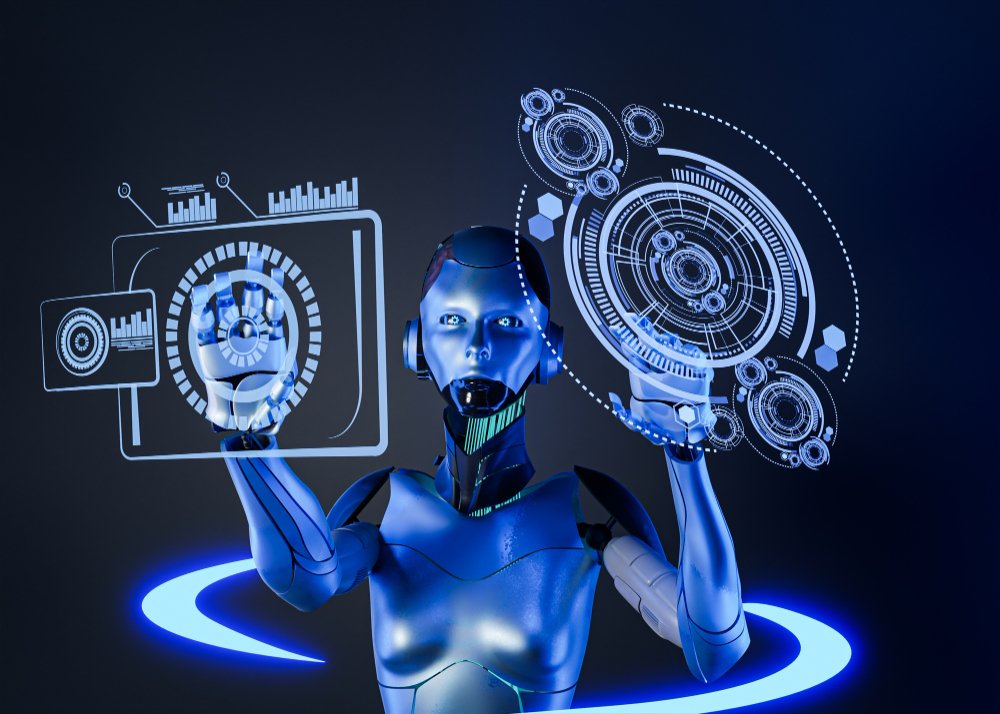
How Intelligent Software Is Changing the Way We Work
Documentary Script — Approx. 15–18 Minutes
OPENING — THE TOOLS HAVE CHANGED
[BLACK SCREEN]
SFX: Keyboard clicks. A notification sound. Low cinematic electronic music.
NARRATOR:
There was a time when creating something on a computer required knowing exactly how the software worked.
You needed to understand the menus.
The buttons.
The commands.
The technical language.
Then something changed.
Instead of learning the machine…
we began teaching the machine what we wanted.
[VISUAL: A person typing a simple sentence into an AI interface.]
Write this.
Explain that.
Create an image.
Analyze this document.
Build the website.
Write the code.
Summarize the meeting.
Make the presentation.
Find the information.
And increasingly—
do the task for me.
These are AI tools.
And they are changing something much bigger than software.
They are changing the relationship between humans and computers.
CHAPTER ONE — WHAT IS AN AI TOOL?
[VISUAL: Different AI interfaces appearing across a digital screen.]
NARRATOR:
An AI tool is software that uses artificial intelligence to perform tasks that traditionally required human judgment, language skills, perception, or analysis.
But the phrase “AI tool” now covers an enormous range of technologies.
There are AI writing assistants.
Image generators.
Video generators.
Voice and music systems.
Coding assistants.
Research tools.
Data-analysis platforms.
Presentation makers.
Design applications.
Meeting assistants.
Translation systems.
And autonomous AI agents.
Some are built for one specific task.
Others can perform dozens of different jobs.
The important change is not simply that AI can generate content.
It is that AI is becoming a general-purpose interface for software.
Instead of learning every application separately…
people can increasingly describe what they want in ordinary language.
CHAPTER TWO — THE RISE OF THE AI ASSISTANT
[VISUAL: Person working at a desk. Multiple browser tabs disappear as one AI interface appears.]
NARRATOR:
For decades, computers followed instructions.
Humans had to learn the language of the machine.
AI began reversing that relationship.
Large language models made it possible to communicate with software using natural language.
A person could ask a question.
Request an explanation.
Provide a document.
Ask for an analysis.
Or describe a problem.
The software could respond conversationally.
This changed the computer from a passive tool into something that could participate in a workflow.
AI assistants such as ChatGPT, Gemini, Claude and other systems demonstrated just how powerful this interaction could become.
Suddenly, one interface could help with writing, brainstorming, research, coding, planning and learning.
The computer was no longer simply waiting for commands.
It was beginning to understand intentions.
CHAPTER THREE — AI WRITING TOOLS
[VISUAL: Blank document transforming into an article, email and report.]
NARRATOR:
One of the earliest major categories of AI tools was writing.
A blank page has always been intimidating.
AI changed that.
Give an AI system a topic—
and it can generate an outline.
Give it rough notes—
and it can organize them.
Give it a complicated paragraph—
and it can simplify the language.
Ask for a professional email—
and it can produce a draft within seconds.
For writers, marketers, students and businesses, this can dramatically reduce the time required to move from an idea to a first draft.
But there is an important distinction.
AI can generate words.
It does not automatically provide expertise.
A convincing paragraph can still contain an incorrect claim.
A polished report can still be based on incomplete information.
The most effective users therefore treat AI writing tools as collaborators—
not unquestionable authorities.
The human still needs to provide context.
Check facts.
Apply judgment.
And take responsibility for the final result.
CHAPTER FOUR — AI IMAGE GENERATORS
[VISUAL: Text prompt transforming into a cinematic image.]
NARRATOR:
Then AI entered another creative world:
Images.
For decades, creating professional visual content required specialized software and technical skills.
AI image generators changed the equation.
Describe a scene—
and the system can create it.
A futuristic city.
A product concept.
A fantasy landscape.
A marketing visual.
A character design.
A scientific illustration.
An architectural idea.
The barrier between imagination and visual output became dramatically smaller.
A person who has never studied traditional digital art can now experiment with visual concepts using language.
But this technology also created major debates.
What data was used to train these systems?
How should artists’ work be treated?
Who owns an AI-generated image?
And what happens when synthetic images become indistinguishable from photographs?
AI image generation has made visual creation easier.
But it has also forced society to rethink what an image actually proves.
CHAPTER FIVE — AI VIDEO AND AUDIO
[VISUAL: Text prompt → generated video → voice waveform → finished scene.]
NARRATOR:
The next frontier was video.
Video production traditionally requires cameras, actors, lighting, editing and extensive post-production.
Generative AI is changing parts of that process.
A written description can become a visual sequence.
A still image can be animated.
A voice can be generated.
Audio can be translated.
And creative concepts can be tested before expensive production begins.
AI tools can therefore act as virtual production assistants.
A filmmaker can experiment with ideas.
A business can create promotional material.
An educator can produce visual explanations.
A creator can turn a script into a video concept.
But once again, the technology introduces a problem.
If AI can generate realistic people saying things they never said…
how do we know what is real?
Deepfakes and synthetic media have transformed misinformation from a problem of manipulated information into a problem of manipulated reality.
The more convincing AI becomes,
the more important verification becomes.
CHAPTER SIX — AI CODING TOOLS
[VISUAL: Programmer typing. Code appears automatically. Software interface builds itself.]
NARRATOR:
Perhaps one of the most important changes is happening inside software development.
AI coding assistants can generate code from natural-language instructions.
A developer can describe a function.
Ask for an explanation.
Request a debugging suggestion.
Generate tests.
Or ask an AI system to help build an application.
This does not mean programmers are becoming unnecessary.
Instead, the nature of programming is changing.
Developers increasingly spend less time typing repetitive code—
and more time defining architecture, reviewing output and solving complex problems.
The question is shifting from:
“Can you write this code?”
to:
“Do you understand what this software should actually do?”
That distinction matters.
Because AI can generate code quickly.
But software still needs to be tested, secured, maintained and understood.
CHAPTER SEVEN — AI RESEARCH TOOLS
[VISUAL: Thousands of documents being scanned. Research papers appearing on screen.]
NARRATOR:
The internet contains an almost unimaginable amount of information.
The problem is not finding information.
The problem is finding the right information.
AI research tools are designed to help with that problem.
They can summarize documents.
Compare sources.
Extract important information.
Organize notes.
Answer questions about large collections of material.
And help researchers move through information more quickly.
Imagine a researcher facing hundreds of papers.
Instead of manually reading every abstract before deciding where to focus, AI can help organize the landscape.
But there is a warning.
A summary is not the same as understanding.
And an AI-generated answer is not automatically evidence.
Research still requires primary sources, verification and critical thinking.
AI can accelerate research.
It cannot eliminate the responsibility to research properly.
CHAPTER EIGHT — AI DATA ANALYSIS TOOLS
[VISUAL: Spreadsheet transforming into charts and insights.]
NARRATOR:
Data is everywhere.
Sales figures.
Customer behavior.
Website traffic.
Financial records.
Scientific measurements.
Operational data.
But raw data means very little without interpretation.
AI-powered data tools allow people to interact with information using natural language.
Instead of manually searching through thousands of rows, a user can ask:
“What changed this quarter?”
“Which products are performing differently?”
“Find unusual patterns.”
“Create a forecast.”
“Explain this chart.”
The AI can help transform raw information into something humans can understand.
For businesses, this could dramatically reduce the technical barrier to data analysis.
But once again, there is a limitation.
A statistical pattern does not automatically explain its cause.
AI can identify what happened.
Humans may still need to determine why.
CHAPTER NINE — AI DESIGN TOOLS
[VISUAL: Designer creating a logo, presentation and website.]
NARRATOR:
Design has also been transformed.
AI tools can help create layouts.
Generate images.
Remove backgrounds.
Edit photographs.
Produce presentation concepts.
Create marketing materials.
And generate early versions of websites and applications.
For professional designers, these systems can reduce repetitive tasks.
For non-designers, they can make visual creation accessible.
This creates an important shift.
Software used to give people tools.
AI increasingly gives people outcomes.
Instead of asking:
“Which tool should I use?”
people can ask:
“What do I want to create?”
And the software can help determine the process.
CHAPTER TEN — AI MEETING AND PRODUCTIVITY TOOLS
[VISUAL: Virtual meeting. AI automatically generating notes.]
NARRATOR:
Modern work produces another valuable resource:
information.
Meetings.
Emails.
Documents.
Messages.
Calls.
Decisions.
AI productivity tools can help capture and organize this information.
A meeting can be transcribed.
Important points can be summarized.
Tasks can be identified.
Follow-ups can be drafted.
Long conversations can become searchable records.
The result is a subtle but powerful change.
People no longer have to remember everything.
The software can remember the conversation for them.
But that creates a new responsibility:
What information should an AI system be allowed to remember?
CHAPTER ELEVEN — AI AUTOMATION
[VISUAL: Multiple applications connecting through glowing digital pathways.]
NARRATOR:
Automation is not new.
Companies have automated processes for decades.
But traditional automation usually followed fixed rules.
If this happens—
do that.
AI automation is different.
AI can interpret less-structured information.
Read messages.
Understand documents.
Classify requests.
Generate responses.
And decide which step should come next.
This makes it possible to automate workflows that were previously too complicated to automate.
For example:
A customer sends an email.
AI understands the request.
Finds the relevant account information.
Classifies the problem.
Drafts a response.
Updates a system.
And sends the case to a human if the situation requires judgment.
Automation is becoming more flexible.
And that brings us closer to the era of AI agents.
CHAPTER TWELVE — AI AGENTS
[VISUAL: An AI system moving between browser windows and applications.]
NARRATOR:
This may be the most important evolution in AI tools.
The AI agent.
A traditional AI tool waits for a request.
An agent can pursue a goal.
You might say:
“Research this market and prepare a report.”
The agent could break the task into smaller steps.
Search for information.
Analyze documents.
Organize findings.
Create a report.
And potentially use other software along the way.
This changes the meaning of an AI tool.
It is no longer just something you open.
It becomes something you delegate work to.
And as these systems become more capable, one question becomes increasingly important:
How much authority should an AI agent have?
CHAPTER THIRTEEN — THE DARK SIDE OF AI TOOLS
[MUSIC BECOMES DARKER.]
[VISUAL: Fake video. Cybersecurity alerts. Data flowing through servers.]
NARRATOR:
Every powerful tool can be used for different purposes.
AI is no exception.
AI can improve productivity.
But it can also automate scams.
Generate misinformation.
Assist cyberattacks.
Create fraudulent content.
Impersonate people.
And amplify harmful information.
There are also concerns about privacy.
An AI system may process documents containing confidential business information.
It may handle personal data.
It may have access to emails, files or other applications.
That means choosing an AI tool is not simply a question of:
“Is it powerful?”
It is also:
“What happens to my data?”
“Who can access it?”
“How is the information stored?”
“What permissions does the tool have?”
The smartest tool is not always the safest tool for every situation.
CHAPTER FOURTEEN — THE AI TOOLBOX OF THE FUTURE
[VISUAL: Hundreds of AI applications merging into one interface.]
NARRATOR:
Today, people often think about AI tools as separate applications.
One for writing.
One for images.
One for video.
One for coding.
One for research.
One for data.
But that separation may not last.
The future could bring unified AI systems capable of handling multiple types of work.
You provide a goal.
The AI determines which capabilities it needs.
It searches.
Writes.
Analyzes.
Creates.
Codes.
And coordinates different tools.
The interface becomes simpler.
The underlying technology becomes more complicated.
And the user may not even know which model or application performed each individual step.
The AI becomes the operating layer between humans and software.
CHAPTER FIFTEEN — WILL AI TOOLS REPLACE PEOPLE?
[VISUAL: Human worker sitting beside an AI interface.]
NARRATOR:
This is the question people ask most often.
Will AI tools replace human workers?
There is no single answer.
Some tasks will undoubtedly become automated.
Some jobs will change.
New roles will emerge.
And many existing professions will incorporate AI into everyday workflows.
History shows that technology often changes the composition of work rather than simply eliminating all work.
The bigger question may be:
Which human abilities become more valuable when machines become better at routine tasks?
Critical thinking.
Communication.
Leadership.
Creativity.
Domain expertise.
Decision-making.
Human relationships.
And the ability to understand what should be done—
not merely how to do it.
CHAPTER SIXTEEN — THE NEW DIGITAL SKILL
[VISUAL: Young person learning. Professional experimenting with AI tools.]
NARRATOR:
There is another major shift happening.
Knowing how to use AI is becoming a digital skill.
But effective AI use is not simply about knowing clever prompts.
It involves understanding the strengths and weaknesses of the technology.
Knowing when to trust an output.
Knowing when to verify it.
Knowing how to protect sensitive information.
Knowing how to structure a problem.
And knowing how to combine AI with human judgment.
The most valuable AI user may not be the person who knows the most tools.
It may be the person who knows:
which tool to use,
for which problem,
and when not to use one at all.
FINAL CHAPTER — THE TOOL IS NOT THE FUTURE
[VISUAL: A person closes a laptop and looks outside at a modern city.]
NARRATOR:
AI tools are becoming faster.
Smarter.
More capable.
More accessible.
But the technology itself is not the real story.
The real story is what happens when millions of people gain access to capabilities that previously required specialized knowledge.
A student can become a researcher.
A small business can access sophisticated marketing capabilities.
A designer can prototype faster.
A developer can build with fewer resources.
A scientist can analyze more information.
A creator can turn an idea into a visual experience.
And an ordinary person can interact with powerful computing using nothing more than natural language.
That is the promise.
But there is another side.
When powerful capabilities become easy to access, responsibility becomes more important—not less.
We will need to decide how AI tools are used.
Which decisions should remain human.
What information should remain private.
What systems deserve our trust.
And where automation should stop.
Because AI tools are not simply changing software.
They are changing the boundary between what humans imagine and what humans can actually create.
[PAUSE]
The computer used to wait for us.
Now it can help us think.
Create.
Analyze.
Build.
And increasingly—
act.
The AI tool revolution has only just begun.
[BLACK SCREEN]
TEXT ON SCREEN:
THE FUTURE OF AI IS NOT JUST INTELLIGENCE.
IT IS WHAT THAT INTELLIGENCE ALLOWS US TO DO.
FADE OUT.